All Saints' Day
From Wikipedia, the free encyclopedia
Jump to navigation
Jump to search
| All Saints' Day |
|---|
|
| Also called | All Hallows' Day, Hallowmas |
|---|
| Observed by |
|
|---|
| Liturgical Color | White (Western Christianity)
Green (Eastern Christianity) |
|---|
| Type | Christian |
|---|
| Observances | Church services, praying for the dead, visiting cemeteries, eating soul cakes |
|---|
| Date | 1 November (Western Christianity)
Sunday after Pentecost (Eastern Christianity) |
|---|
| Frequency | annual |
|---|
| Related to |
|
|---|
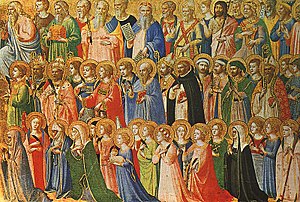
All Saints' Day, also known as
All Hallows' Day,
Hallowmas,
[3][4] the
Feast of All Saints,
[5][6] or
Solemnity of All Saints,
[7] is a
Christian festival celebrated in honour of all the
saints, known and unknown. In
Western Christianity, it is celebrated on 1 November by the
Roman Catholic Church, the
Anglican Communion, the
Methodist Church, the
Church of the Nazarene[8], the
Lutheran Church, the
Reformed Church, and other Protestant churches. The
Eastern Orthodox Church and associated
Eastern Catholic Churches and
Byzantine Lutheran Churches celebrate it on the first Sunday after
Pentecost.
[9] Oriental Orthodox churches of Chaldea and associated Eastern Catholic churches celebrate All Saints' Day on the first Friday after Easter.
[10]
In the Western Christian practice, the
liturgical celebration begins at
Vespers on the evening of 31 October,
All Hallows' Eve (All Saints' Eve), and ends at the close of 1 November. It is thus the day before
All Souls' Day, which commemorates the faithful departed. In many traditions, All Saints' Day is part of the season of
Allhallowtide, which includes the three days from 31 October to 2 November inclusive and in some denominations, such as
Anglicanism, extends to
Remembrance Sunday.
[11][12]
On All Saints Day, it is common for families to attend church, as well
as visit cemeteries in order to lay flowers and candles on the graves of
their deceased loved ones.
[13] In Austria and Germany,
godparents gift their godchildren
Allerheiligenstriezel (All Saint's Braid) on All Saint's Day,
[14] while the practice of
souling remains popular in Portugal.
[15] It is a
national holiday in many historically
Christian countries.
The Christian celebration of All Saints' Day and All Souls' Day
stems from a belief that there is a powerful spiritual bond between
those in heaven (the "
Church triumphant"), and the living (the "
Church militant"). In
Catholic theology, the day commemorates all those who have attained the
beatific vision in Heaven. In
Methodist theology, All Saints Day revolves around "giving God solemn thanks for the lives and deaths of his
saints", including those who are "famous or obscure".
[16] As such, individuals throughout the Church Universal are honoured, such as
Paul the Apostle,
Augustine of Hippo and
John Wesley, in addition to individuals who have personally led one to faith in Jesus, such as one's grandmother or friend.
[16]
In the British Isles, it is known that churches were already
celebrating All Saints on 1 November at the beginning of the 8th century
to coincide with or replace the Celtic festival of
Samhain.
[17][18][19][20]
James Frazer suggests that 1 November was chosen because it was the date
of the Celtic festival of the dead (Samhain). However, Ronald Hutton
points out that, according to
Óengus of Tallaght
(d. ca. 824), the 7th/8th century church in Ireland celebrated All
Saints on 20 April. He suggests that 1 November date was a Germanic
rather than a Celtic idea.
[17]
In Eastern Europe and Western Asia
The
Eastern Orthodox Church, following the Byzantine tradition, commemorates all saints collectively on the first Sunday after
Pentecost,
All Saints' Sunday (Greek: Ἁγίων Πάντων,
Agiōn Pantōn).
The feast of All Saints achieved great prominence in the 9th century, in the reign of the
Byzantine Emperor Leo VI "the Wise" (866–911). His wife, Empress
Theophano – commemorated on 16 December – lived a devout life. After her death in 893,
[21]
her husband built a church, intending to dedicate it to her. When he
was forbidden to do so, he decided to dedicate it to "All Saints", so
that if his wife were in fact one of the righteous, she would also be
honoured whenever the feast was celebrated.
According to tradition, it was Leo who expanded the feast from a
commemoration of All Martyrs to a general commemoration of All Saints,
whether martyrs or not.
This Sunday marks the close of the
Paschal season. To the normal Sunday services are added special scriptural readings and hymns to all the saints (known and unknown) from the
Pentecostarion.
In the late spring, the Sunday following Pentecost Saturday (50
days after Easter) is set aside as a commemoration of all locally
venerated saints, such as "All Saints of America", "All Saints of
Mount Athos", etc. The third Sunday after Pentecost may be observed for even more localised saints, such as "All Saints of
St. Petersburg", or for saints of a particular type, such as "
New Martyrs of the Turkish Yoke".
In addition to the Mondays mentioned above, Saturdays throughout
the year are days for general commemoration of all saints, and special
hymns to all saints are chanted from the
Octoechos.
The celebration of 1 November in Lebanon as a holiday is simply
the influence of Western Catholic orders present in Lebanon and is not
Maronite in origin. The traditional Maronite feast equivalent to the
honor of all saints in their liturgical calendar is one of three Sundays
in preparation for Lent called the Sunday of the Righteous and the
Just. The following Sunday is the Sunday of the Faithful Departed
(similar to All Souls Day in Western calendar).
In East Syriac tradition the All Saints Day celebration falls on the first Friday after resurrection Sunday.
[10]
This is because all departed faithful are saved by the blood of Jesus
and they resurrected with the Christ. Normally in east Syriac liturgy
the departed souls are remembered on Friday. Church celebrates All souls
day on Friday before the beginning of Great lent or Great Fast.
[23]
In Western Europe, the Americas and the Philippines
The Christian holiday of All Saints' Day falls on 1 November, followed by
All Souls' Day on 2 November, and is currently a Solemnity in the
Roman Rite of the Catholic Church, a
Festival in the
Lutheran Churches, as well as a
Principal Feast of the Anglican Communion.
In the early days the Christians were accustomed to solemnise the
anniversary of a martyr's death for Christ at the place of martyrdom.
In the 4th century, neighbouring dioceses began to interchange feasts,
to transfer relics, to divide them, and to join in a common feast; as is
shown by the invitation of St. Basil of Caesarea (397) to the bishops
of the province of Pontus. In the persecution of Diocletian the number
of martyrs became so great that a separate day could not be assigned to
each. But the Church, feeling that every martyr should be venerated,
appointed a common day for all. The first trace of this we find in
Antioch on the Sunday after Pentecost. We also find mention of a common day in a sermon of St.
Ephrem the Syrian (373), and in the 74th homily of St.
John Chrysostom (407). According to Ephrem, this feast was observed at
Edessa on 13 May, and John Chrysostom says it was on the Sunday after Pentecost in
Constantinople.
[24] As early as 411 there is in the Chaldean Calendar a "Commemoratio Confessorum" for the Friday after Easter.
[25]
On 13 May 609 or 610,
Pope Boniface IV consecrated the
Pantheon at Rome to the Blessed Virgin and all the martyrs, ordering an anniversary;
[25] the feast of the
dedication Sanctae Mariae ad Martyres
has been celebrated at Rome ever since. There is evidence that from the
5th to the 7th centuries there existed in certain places and at
sporadic intervals a feast date on 13 May to celebrate the holy martyrs.
[26]
The origin of All Saints' Day cannot be traced with certainty, and it
has been observed on various days in different places. However, there
are some who maintain the belief that it has origins in the
pagan observation of 13 May, the
Feast of the Lemures, in which the malevolent and restless spirits of the dead were propitiated. Some liturgiologists base the idea that this
Lemuria festival was the origin of that of All Saints on their identical dates and on the similar theme of "all the dead".
[27]
Meanwhile, others consider that 13 May was perhaps deliberately chosen
by the Pope because of its celebration already established in the East.
[28]
The feast of All Saints, on its current date, is traced to the foundation by
Pope Gregory III (731–741) of an
oratory in
St. Peter's
for the relics "of the holy apostles and of all saints, martyrs and
confessors, of all the just made perfect who are at rest throughout the
world", with the date moved to 1 November and 13 May feast suppressed.
[30]
This fell on the
Celtic holiday of
Samhain, which had a theme similar to the Roman festival of
Lemuria,
but which was also a harvest festival. The Irish, having celebrated
Samhain in the past, did not celebrate All Hallows Day on this 1
November date, as extant historical documents attest that the
celebration in Ireland took place in the spring: "... the
Felire of
Oengus and the
Martyrology of Tallaght prove that the early medieval churches [in Ireland] celebrated the feast of All Saints on 20 April."
[31]
A November festival of all the saints was already widely celebrated on 1 November in the days of
Charlemagne. It was made a day of obligation throughout the
Frankish empire in 835, by a decree of
Louis the Pious, issued "at the instance of
Pope Gregory IV and with the assent of all the bishops", which confirmed its celebration on 1 November. The
octave was added by
Pope Sixtus IV (1471–1484).
The festival was retained after the
Reformation in the calendar of the
Anglican Church and in many
Lutheran churches. In the Lutheran churches, such as the
Church of Sweden, it assumes a role of general commemoration of the dead. In the
Swedish calendar,
the observance takes place on the Saturday between 31 October and 6
November. In many Lutheran Churches, it is moved to the first Sunday of
November. In the
Church of England,
mother church of the
Anglican Communion, it is a
Principal Feast and may be celebrated either on 1 November or on the Sunday between 30 October and 5 November. It is also celebrated by other
Protestants of the English tradition, such as the
United Church of Canada, the
Methodist churches and the
Wesleyan Church.
Protestants generally commemorate all Christians, living and
deceased, on All Saints' Day; if they observe All Saints Day at all,
they use it to remember all Christians both past and present. In the
United Methodist Church,
All Saints' Day is celebrated on the first Sunday in November. It is
held, not only to remember Saints, but also to remember all those who
have died who were members of the local church congregation. In some
congregations, a candle is lit by the
Acolyte
as each person's name is called out by the clergy. Prayers and
responsive readings may accompany the event. Often, the names of those
who have died in the past year are affixed to a memorial plaque.
In many Lutheran churches, All Saints' Day is celebrated the
Sunday after Reformation is celebrated (the date for Reformation is 31
October, so Reformation Sunday is celebrated on or before 31 October).
In most congregations, the festival is marked as an occasion to remember
the dead. The names of those who have died from the congregation within
the last year are read during worship and a bell is tolled, a chime is
played or a candle is lit for each name read. While the dead are
solemnly remembered during worship on All Saints' Sunday, the festival
is ultimately a celebration of
Christ's victory over death.
In English-speaking countries, services often include the singing of the traditional hymn "
For All the Saints" by
Walsham How. The most familiar tune for this hymn is
Sine Nomine by
Ralph Vaughan Williams. Other hymns that are popularly sung during corporate worship on this day are "
I Sing a Song of the Saints of God" and "
Ye Watchers and Ye Holy Ones".
Customs
All Saints' Day at a cemetery in
Gniezno, Poland – flowers and candles placed to honor deceased relatives (2017)
Europe
In some countries, All Saints' Day is a public holiday, but All
Souls' Day is not. Consequently, people will visit the cemetery on All
Saints. In Bosnia and Herzegovina, Croatia, the Czech Republic, Finland,
Catholic parts of Germany, Hungary, Italy, Lithuania, Macedonia,
Moldova, Poland, Romania, Slovakia, Slovenia, Serbia, and Sweden the
tradition is to light candles and visit the graves of deceased
relatives.
In Austria and Bavaria it is customary on All Saints' Day for godfathers to give their godchildren
Allerheiligenstriezel, a braided yeast pastry.
[32]
In France, and throughout the
Francophone world, the day is known as
La Toussaint. Flowers (especially in
Chrysanthemums), or wreaths called 'couronnes de toussaints' are placed at each tomb or grave. The following day, 2 November (
All Souls' Day) is called
Le jour des morts, the Day of the Dead.
[33]
In Belgium, "Toussaint" is a public holiday. Belgians will visit the
cemetery to place chrysanthemums on the graves of deceased relatives on
All Saints Day since All Souls is not a holiday.
[34]
In Portugal,
Dia de Todos os Santos is a national holiday.
Families remember their dead with religious observances and visits to
the cemetery. Portuguese children celebrate the
Pão-por-Deus tradition (also called
santorinho,
bolinho or
fiéis de Deus) going door-to-door, where they receive cakes, nuts, pomegranates, sweets and candies.
[35]
In Spain, el
Día de Todos los Santos is a national holiday. The play
Don Juan Tenorio is traditionally performed.
[36]
The Americas
In Argentina, Brasil, Bolivia, Chile, Ecuador, Peru, Puerto Rico, Uruguay and the state of
Louisiana, people take flowers to the graves of dead relatives.
All Saints' Day in Mexico coincides with the first day of the
Day of the Dead (
Día de Muertos) celebration. It commemorates children who have died (
Dia de los Inocentes) and the second day celebrates all deceased adults.
[37]
In Guatemala, All Saints' Day is a national holiday. On that day Guatemalans make a special meal called
fiambre which is made of cold meats and vegetables; it is customary to visit cemeteries and to leave some of the
fiambre
for their dead. It is also customary to fly kites to help unite the
dead with the living. There are festivals in towns like Santiago
Sacatepéquez and Sumpango, where giant colorful kites are flown.
[38]
In the United States and Canada,
Halloween is celebrated in connection with All Saints' Day,
[39]
although celebrations are generally limited to 31 October. During the
20th century the observance largely became a secular one, although some
Christian groups have continued to embrace the Christian origins of the
holiday whereas others (typically
Protestant groups) have rejected celebrations.
[40][41] On Halloween night, children dress in
costumes and go door to door asking for candy in a practice known as
trick-or-treating,
[42] while adults may host costume parties. There are many popular customs associated with Halloween, including carving a
pumpkin into a
Jack-o'-lantern and
apple bobbing.
[43] Halloween is not a
public holiday in either the United States or Canada.
Philippines
Hallow-mas in the Philippines is variously called "
Undás", "
Todos los Santos" (Spanish, "All Saints"), and sometimes "
Araw ng mga Patay / Yumao" (
Tagalog,
"Day of the dead / those who have passed away"), which actually refers
to the following day of All Souls' Day but includes it. Filipinos
traditionally observe this day by visiting the family dead to clean and
repair their tombs. Offerings of prayers, flowers, candles,
[44] and even food, while
Chinese Filipinos additionally burn
incense and
kim. Many also spend the day and ensuing night holding reunions at the cemetery, having feasts and merriment.
Though Halloween has usually been seen as an American influence
in the Philippines, the country's trick-or-treat traditions during Undas
(from the Spanish "Honras", meaning honours, as in "with honors") are
actually much older. This tradition was derived from the pre-colonial
tradition called pangangaluwa. Pangangaluluwa (from "kaluluwa" or spirit
double) was a practice of early Filipinos who sang from house to house
swathed in blankets pretending to be ghosts of ancestors. If the owner
of the house failed to give biko or rice cakes to the "nangangaluluwa",
the "spirits" would play tricks (try to steal slippers or other objects
left outside the house by members of the family or run off with the
owner's chickens). This pre-colonial practice is still seen in rural
areas. During Undas, family members visit the cemetery where the body of
the loved ones rest. It is believed that by going to the cemetery and
offering food, candles, flowers, and sometimes incense sticks, the
spirit of the loved one is remembered and appeased. Contrary to common
belief, this visitation practice is not an imported tradition. Prior to
the establishment of coffins, pre-colonial Filipinos were already
practicing such a tradition of visiting burial caves throughout the
archipelago as confirmed by a research conducted by the
University of the Philippines.
The tradition of "atang" or "hain" is also practiced, where food and
other offerings are placed near the grave site. If the family cannot go
to the grave site, a specific area in the house is provided for the
offering. The exact date of Undas today, 1 November, is not a
pre-colonial observance date but an influence from Mexico, where the
same day is known as the Day of the Dead. Pre-colonial Filipinos
preferred going to the burial caves of the departed occasionally as they
believed that aswang (half-vampire half-werewolf beings) would take the
corpse of the dead if the body was not properly guarded. The protection
of the body of the loved one is called "paglalamay". However, in some
communities, this paglalamay tradition is non-existent and is replaced
by other pre-colonial traditions unique to each community. The Undas is
also seen as a family reunion, where family members coming from various
regions go back to their hometown to visit the grave of loved ones.
Family members are expected to remain beside the grave for the entire
day and socialize with each other to mend bonds and enhance family
relations. In some cases, family members going to certain burial sites
exceed one hundred people. Fighting in any form is prohibited during
Undas. Children have important roles during Undas. Children are allowed
to play with melted candles in front of grave sites and turn the melted
wax from the candles into round wax balls. The round balls of wax
symbolize the affirmation that everything goes back to where it began,
as the living will go back to ash, where everything started. In some
cases, families also light candles at the front door of the home. The
number of candles is equivalent to the number of departed loved ones. It
is believed that this tradition aids departed loved ones and provide
them with a happy path to the afterlife.
[45][46][47]
See also
Notes
Marty, Martin E. (2007). Lutheran questions, Lutheran answers: exploring Christian faith. Minneapolis: Augsburg Fortress. p. 127. ISBN 978-0806653501. Retrieved 2 November 2011. All Lutherans celebrate All Saints Day, and many sing, 'For all the saints, who from their labors rest...'
Willimon, William H. (2007). United Methodist Beliefs. Westminster John Knox Press. p. 64. ISBN 978-1611640618. Retrieved 30 October 2014.
"Shakespearian Glossary". Archived from the original on 23 April 2014. Retrieved 10 April 2014.
The Shakespeare Name Dictionary. Routledge. 2004. ISBN 978-1135875718. Retrieved 30 October 2014.
The Anglican Service Book. Good Shepherd Press. 1 September 1991. p. 677. ISBN 978-0962995507. Retrieved 3 November 2012.
St. John of Shanghai and San Francisco. "Homily on the Feast of All Saints of Russia". St. John Chrysostom Orthodox Church.
Roman Missal
"Celebrations and Observances of the Church Year". www.thefoundrypublishing.com. Retrieved 25 April 2019.
Sidhu, Salatiel; Baldovin, John Francis (5 February 2013). Holidays and Rituals of Jews and Christians. p. 193. ISBN 978-1481711401. Lutheran
and Orthodox Churches who do not call themselves Roman Catholic
Churches have maintained the traditions of the Roman Catholic Church,
still celebrate this Day. Even the Protestant Churches like the United
Methodist Church all celebrate this day as the All Souls Day and call it
All Saints day.
"Syro Malabar Liturgical Calendar 2016" (PDF).
Leslie, Frank (1895). Frank Leslie's Popular Monthly. Allhallowtide. Frank Leslie Publishing House. p. 539. Retrieved 9 April 2014. Just
as the term "Eastertide" expresses for us the whole of the church
services and ancient customs attached to the festival of Easter, from
Palm Sunday until Easter Monday, so does All-hallowtide include for us
all the various customs, obsolete and still observed, of Halloween, All
Saints' and All Souls' Days. From the 31st of October until the morning
of the 3d of November, this period of three days, known as
All-hallowtide, is full of traditional and legendary lore.
"All Saints' Tide". Services and Prayers for the Season from All Saints to Candlemas. General Synod of the Church of England. For
many twentieth-century Christians the All Saints-tide period is
extended to include Remembrance Sunday. In the Calendar and Lectionary
we have sought to make it easier to observe this without cutting across a
developing lectionary pattern, and we have reprinted the form of
service approved ecumenically for use on that day.
Hatch, Jane M. (1978). The American Book of Days. Wilson. p. 979. ISBN 978-0824205935.
Williams, Victoria (2016). Celebrating Life Customs around the World. ABC-CLIO. p. 979.
Guillain, Charlotte (2014). Portugal. Capstone.
Iovino, Joe (28 October 2015). "All Saints Day: A holy day John Wesley loved". The United Methodist Church. Retrieved 20 October 2016.
Hutton, p. 364
Pseudo-Bede, Homiliae subdititiae; John Hennig, 'The Meaning of All the Saints', Mediaeval Studies 10 (1948), 147–61.
"All Saints Day", The Oxford Dictionary of the Christian Church, 3rd edition, ed. E. A. Livingstone (Oxford: Oxford University Press, 1997), 41–42; The New Catholic Encyclopedia, eo.loc.
Hennig, John (1946). "A Feast of All the Saints of Europe". Speculum. 21 (1): 49–66. JSTOR 2856837.
The date in Vita Euthymii, not printed until 1888 "makes it seem practically (though not absolutely) certain that she died on 10 Nov. 893".(Downey 1956, pp. 301–305)
""Commemoration of the Departed Faithful"". Nasrani Foundation.
Holy Women, Holy Men: Celebrating the Saints. Church Publishing, Inc. 2010. p. 662. ISBN 978-0898696783.
Mershman, Francis (1907). "All Saints' Day". The Catholic Encyclopedia. Vol. 1. New York: Robert Appleton Company. Retrieved 30 October 2014.
C. Smith The New Catholic Encyclopedia 1967: s.v. "Feast of All Saints", p. 318.
For example, Violet Alford ("The Cat Saint", Folklore 52.3 [September 1941:161–183] p. 181 note 56) observes that "Saints were often confounded with the Lares
or Dead. Repasts for both were prepared in early Christian times, and
All Saints' Day was transferred in 835 to November 1st from one of the
days in May which were the old Lemuralia"; Alford notes Pierre Saintyves, Les saints successeurs des dieux, Paris 1906 (sic, i.e. 1907).
Saunders, William. "All Saints and All Souls". catholiceducation.org. Retrieved 18 September 2016.
"All Saints' Day", The Oxford Dictionary of the Christian Church, 3rd edition, ed. E. A. Livingstone (Oxford: Oxford University Press, 1997), 41–42; The New Catholic Encyclopedia, eo.loc.
Hutton, Ronald (1996). Stations of the Sun: A History of the Ritual Year in Britain. New York: Oxford Paperbacks. ISBN 0192854488.
Berger, Corinna. "Your Vienna Guide of All Saints' Day", Metropole, 31 October 2017
"The Flower of Death", Couleur Nature, Paris, 25 July 2011
"All Saints' Day honors the deceased", USAG Benelux Public Affairs, November 1, 2017
"National holiday: November 1st is All Saints Day – Portugal", Portuguese American Journal, 1 November 2011
"All Saints' Day in Spain", Estudio Sampere
Trebe, Patricia. "Mexican-Americans to celebrate Day of the Dead", Chicago Tribune, 30 October 2015
Mijangos, Nelo. "All Saints Day in Guatemala", Revue, 2 November 2012
"NEDCO Producers' Guide". 31–33. Northeast Dairy Cooperative Federation. 1973. Originally
celebrated as the night before All Saints' Day, Christians chose
November first to honor their many saints. The night before was called
All Saints' Eve or hallowed eve meaning holy evening.
Halloween: What's a Christian to Do? (1998) by Steve Russo.
Gyles Brandreth, "The Devil is gaining ground" The Sunday Telegraph (London), 11 March 2000.
"Halloween". Encyclopædia Britannica. Archived from the original on 30 October 2012. Retrieved 25 October 2012.
Paul Fieldhouse (17 April 2017). Food, Feasts, and Faith: An Encyclopedia of Food Culture in World Religions. ABC-CLIO. p. 256. ISBN 9781610694124.
"All Saints Day around the world", Guardian Weekly, 1 November 2010
http://www.gmanetwork.com/news/lifestyle/artandculture/386063/contemporary-undas-practices-derived-from-pre-colonial-influence-beliefs-cultural-anthropologist/story/
Cruz, Elfren S. (31 October 2013). "Undas in Filipino culture". The Philippine Star. Retrieved 17 February 2018.
- Attribution
Further reading
- Langgärtner, Georg. "All Saints' Day". In The Encyclopedia of Christianity, edited by Erwin Fahlbusch and Geoffrey William Bromiley, 41. Vol. 1. Grand Rapids: Wm. B. Eerdmans, 1999. ISBN 0802824137.
External links


 This article incorporates text from a publication now in the